The History of Tarot: From Playing Cards to Spiritual Guidance
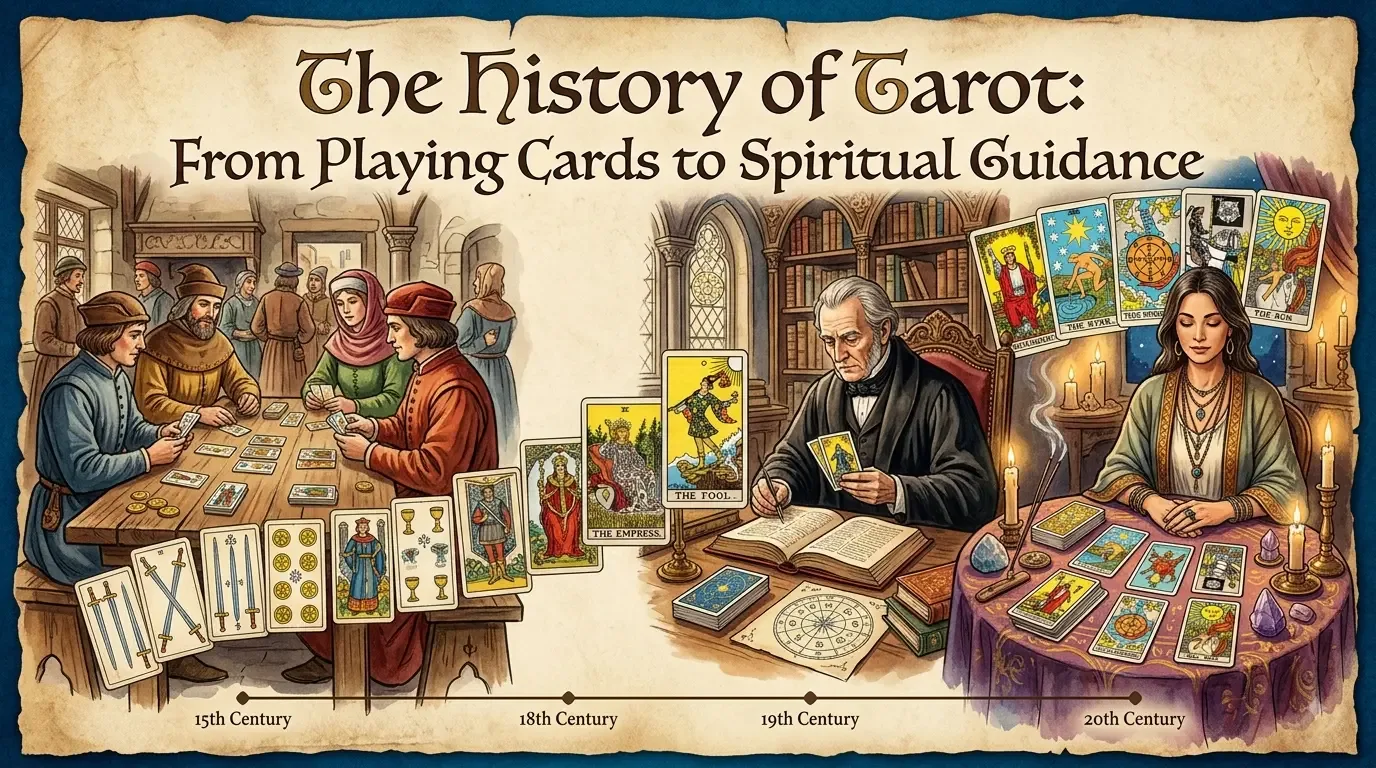
The History of Tarot: From Playing Cards to Spiritual Guidance
Tarot cards are now widely associated with fortune telling, spiritual guidance, self-reflection, and divination. For many people, the familiar 78-card deck seems to have an ancient and mysterious origin. Yet the actual history of Tarot is more fascinating precisely because it is not as ancient as popular culture often suggests.
Tarot did not begin as a mystical system in ancient Egypt, nor was it originally created as a tool for predicting the future. Its earliest documented history begins in Renaissance Europe, where Tarot-like cards appeared as a form of playing card game.
Over the centuries, these cards gradually acquired symbolic, occult, and spiritual meanings. The Tarot we know today is therefore the result of a long cultural evolution—from playing cards, to symbolic images, to a sophisticated system of divination and spiritual exploration.
This article explores that fascinating journey and explains how Tarot transformed from a Renaissance card game into one of the world's best-known systems of spiritual guidance.
1. Did Tarot Really Come from Ancient Egypt?
One of the most persistent stories about Tarot is that its origins can be traced back to ancient Egypt.
According to various theories developed centuries after Tarot first appeared in Europe, the cards supposedly preserved secret Egyptian wisdom, the teachings of the Egyptian god Thoth, or an ancient book containing universal spiritual knowledge.
These theories certainly contributed to Tarot's mysterious reputation. However, there is no reliable historical evidence that Tarot originated in ancient Egypt.
The earliest known Tarot cards appeared in Europe during the 15th century, particularly in northern Italy. Historical evidence points toward Renaissance Europe rather than ancient Egypt as the birthplace of Tarot.
This distinction is important.
Tarot has developed a rich spiritual tradition, but its historical origins and its later symbolic interpretations are two different things. Understanding this difference allows us to appreciate Tarot without relying on legends that cannot be historically verified.
2. Tarot Began as a Card Game
The earliest Tarot decks were not primarily designed for fortune telling.
In 15th-century Italy, wealthy families commissioned beautifully decorated decks for entertainment and social occasions. These cards were often known as trionfi, referring to the special cards that later became associated with the Major Arcana.
One famous example is the Visconti-Sforza Tarot, produced in the 15th century for the aristocratic Visconti and Sforza families of Milan.
These early decks generally contained four ordinary suits, similar to other European playing cards, together with a separate group of special illustrated cards.
The special cards included figures and concepts such as:
The Fool
The Magician
The Empress
The Emperor
The Pope
The Lovers
The Chariot
Justice
The Hermit
The Wheel of Fortune
Death
The Devil
The Tower
The Star
The Moon
The Sun
The World
Many of these images were deeply connected with Renaissance European society, Christianity, morality, philosophy, and ideas about human existence.
At this stage, however, they were not yet part of the standardized occult system familiar to modern Tarot readers.
3. The Rise of the Major Arcana
One of the defining characteristics of Tarot is its division into two major sections: the Major Arcana and the Minor Arcana.
The Major Arcana contains 22 cards, beginning traditionally with The Fool and ending with The World.
These cards depict powerful archetypal images: birth, authority, love, struggle, death, transformation, hope, temptation, destruction, enlightenment, and completion.
The Minor Arcana consists of four suits, each containing numbered cards and court cards.
The exact structure and imagery changed between historical decks, but the basic architecture eventually became remarkably influential.
The 22 Major Arcana cards are particularly important because later occult traditions interpreted them as representing a symbolic journey through the stages of human experience.
This idea would become central to modern Tarot.
4. When Did Tarot Become a Divination System?
This is where the history becomes especially interesting.
Although Tarot cards existed in Europe for centuries, there is little evidence that they were originally created for fortune telling.
The association between Tarot and divination emerged much later, particularly in the 18th century.
French occult writers began to claim that Tarot contained hidden ancient wisdom. One of the most influential figures was Antoine Court de Gébelin, who published ideas connecting Tarot with ancient Egyptian mysteries.
His theories were historically inaccurate, but they had an enormous influence on the future development of Tarot.
Another important figure was Jean-Baptiste Alliette, better known as Etteilla.
Etteilla developed Tarot-based divination methods and helped establish the idea that Tarot cards could be used specifically for fortune telling and occult interpretation.
This marked a major turning point.
Tarot was no longer simply a card game. It was becoming a symbolic language.
5. The Influence of the Occult Tradition
During the 19th century, Tarot became increasingly connected with Western occultism.
Occult organizations and writers began developing elaborate correspondences between Tarot and other esoteric systems, including astrology, numerology, Kabbalah, alchemy, and ceremonial magic.
The idea emerged that every card could represent multiple layers of meaning.
For example, a card might simultaneously represent:
A psychological state
A life event
An astrological correspondence
A spiritual principle
A stage of personal development
A hidden aspect of the self
This symbolic approach transformed Tarot from a simple deck of illustrated cards into a complex interpretive system.
6. The Rider-Waite-Smith Tarot Changes Everything
One of the most important milestones in Tarot history came in the early 20th century with the publication of the Rider-Waite-Smith Tarot.
The deck was developed by occultist Arthur Edward Waite and illustrated by Pamela Colman Smith, and was first published in 1909.
Its influence on modern Tarot cannot be overstated.
Earlier Tarot decks often used relatively simple images for the numbered cards of the Minor Arcana. The Rider-Waite-Smith deck, however, gave each Minor Arcana card a detailed scene.
For example, instead of simply showing three cups, the Three of Cups depicts people celebrating together.
This made the cards much easier to interpret visually.
A beginner could look at the image and begin developing an intuitive understanding of the card without memorizing a long list of traditional meanings.
This design became enormously influential and served as the foundation for countless Tarot decks created afterward.
7. Tarot and the Idea of Archetypes
During the 20th century, Tarot increasingly became connected with psychology and personal development.
The work of Carl Jung, particularly his ideas about archetypes and the collective unconscious, strongly influenced modern approaches to Tarot.
Jung did not create Tarot, nor did he establish the modern Tarot system. However, his psychological ideas provided a powerful framework for understanding why symbolic images can have such a strong effect on the human imagination.
From this perspective, Tarot cards can be understood as visual representations of recurring human experiences.
The Emperor may evoke authority and structure.
The Hermit may represent solitude, reflection, and the search for wisdom.
The Tower can symbolize sudden disruption and the collapse of established structures.
The Star can suggest hope, renewal, and faith in the future.
Whether one views these meanings as spiritual realities or psychological symbols, Tarot can function as a language through which people explore their own experiences.
8. Tarot in the Modern World
Today, Tarot is no longer confined to occult circles.
You can find Tarot readers online, Tarot apps on smartphones, Tarot books in mainstream bookstores, and thousands of independently designed decks created by artists around the world.
Tarot has also entered popular culture.
People use Tarot for many different purposes:
Traditional divination
Relationship questions
Career decisions
Personal reflection
Meditation
Journaling
Spiritual practice
Creative inspiration
Psychological self-exploration
This diversity is one of Tarot's greatest strengths.
A person does not necessarily have to believe that Tarot literally predicts the future in order to find value in a reading.
For some people, Tarot provides spiritual guidance. For others, it acts as a structured method for asking better questions and examining situations from a different perspective.
9. Does Tarot Predict the Future?
This is perhaps the most common question beginners ask.
The answer depends largely on how Tarot is understood.
Traditional fortune-telling approaches may interpret Tarot as providing information about possible future developments.
Other readers take a more psychological approach, treating the cards as symbolic prompts that help people examine their thoughts, emotions, fears, and choices.
There is also a middle position: Tarot can be viewed as a tool for exploring possibilities rather than delivering an unavoidable prediction.
This distinction matters because the future is not necessarily a fixed script.
A Tarot reading may highlight a pattern, a potential outcome, or an overlooked factor. What a person does with that information remains important.
In this sense, Tarot can be less about asking:
“What will happen to me?”
and more about asking:
“What should I understand about the situation I am facing?”
That shift can make Tarot considerably more useful as a tool for reflection and guidance.
10. Why Are Tarot Cards Still Popular?
More than five centuries after the earliest Tarot decks appeared, Tarot continues to fascinate people.
Part of the attraction comes from its visual language.
The cards contain recognizable human experiences: love, ambition, loss, fear, hope, conflict, transformation, isolation, celebration, and renewal.
Another reason is Tarot's flexibility.
A single card can be interpreted on several levels depending on the question and context.
The same card that represents a positive development in one reading may indicate a warning in another.
This does not necessarily mean Tarot is arbitrary. Rather, it reflects the nature of symbolic language.
Symbols acquire meaning through relationships.
The surrounding cards, the question being asked, the position of each card in a spread, and the reader's interpretive framework can all influence the final reading.
11. From Playing Cards to a Symbolic Language
The history of Tarot can therefore be understood as a gradual transformation.
15th century: Tarot emerges in Renaissance Italy as an elaborate form of playing card.
16th–17th centuries: Tarot spreads through parts of Europe and develops into different regional traditions.
18th century: Writers and occultists begin associating Tarot with divination and ancient mystical wisdom.
19th century: Tarot becomes increasingly integrated into Western occultism, astrology, Kabbalah, and other esoteric systems.
20th century: The Rider-Waite-Smith Tarot becomes one of the most influential modern decks, while psychological interpretations gain popularity.
21st century: Tarot becomes a global cultural phenomenon, appearing in books, websites, apps, social media, spiritual communities, and personal practices.
The Tarot of today is therefore not exactly the Tarot of Renaissance Italy.
It is the product of centuries of reinterpretation.
Conclusion: The Ever-Evolving Story of Tarot
The history of Tarot is much more interesting than the simple claim that Tarot is an ancient fortune-telling system.
Its documented journey begins with Renaissance playing cards. Centuries later, occultists transformed those cards into a system of esoteric symbolism. In the 20th century, new decks and psychological interpretations expanded Tarot even further. Today, Tarot continues to evolve as both a spiritual practice and a tool for personal reflection.
Perhaps that is the real secret behind Tarot's enduring popularity.
The cards survived because they are capable of being reinterpreted.
From Renaissance courts to modern digital readings, Tarot has continually adapted to the questions people ask about life, love, uncertainty, identity, and the future.
And perhaps the most interesting question is not whether Tarot has one fixed meaning.
It is why these 78 images have remained capable of speaking to people for centuries.
That question is at the heart of the Tarot tradition—and it is one reason the journey from playing cards to spiritual guidance remains so fascinating.
Recommended reading
How to Do Your First Tarot Reading: A Beginner’s Step-by-Step Guide
If you’re new to Tarot, you may have had this thought: “I have a Tarot deck, but where do I actually start?” With 78 cards, different spreads, upright and…
How Many Tarot Cards Are There? Understanding the 78 Tarot Cards
If you are new to Tarot, one of the first questions you may have is surprisingly simple: How many Tarot cards are there? A standard Tarot deck contains 78…
What Is Tarot? A Beginner’s Guide to Tarot Cards and Readings
If you have ever caught a glimpse of a mesmerizing deck of Tarot cards, adorned with centuries-old imagery and mysterious symbolism, you might have felt a…
Which is Better: Tarot or Lenormand?
When stepping into the world of cartomancy and intuitive card reading, two systems dominate the space: Tarot and Lenormand. If you are trying to decide which system to learn—or which type of reading is right for your current situation—you might wonder: Which one is actually better? The short answer is: Neither is objectively "better," but they are built for entirely different purposes. Tarot acts as a psychological mirror for internal reflection, while Lenormand acts as a practical lens for clear, real-world answers. Here is a deep dive into how they differ, how they work, and how to choose the right one for you.
What is the Difference Between Traditional and Modern Tarot Card Reading?
For centuries, Tarot cards have captured human imagination, evolving from a 15th-century European parlor game into one of the most widely used tools for self-reflection and guidance worldwide. However, if you compare a Tarot session from the 19th century with a reading done today, you will notice a profound shift in mindset, interpretation, and intent. The core symbols on the 78 cards remain largely the same, but how we approach and use them has fundamentally transformed.