How Does Tarot Reading Work? Understanding the Meaning Behind the Cards
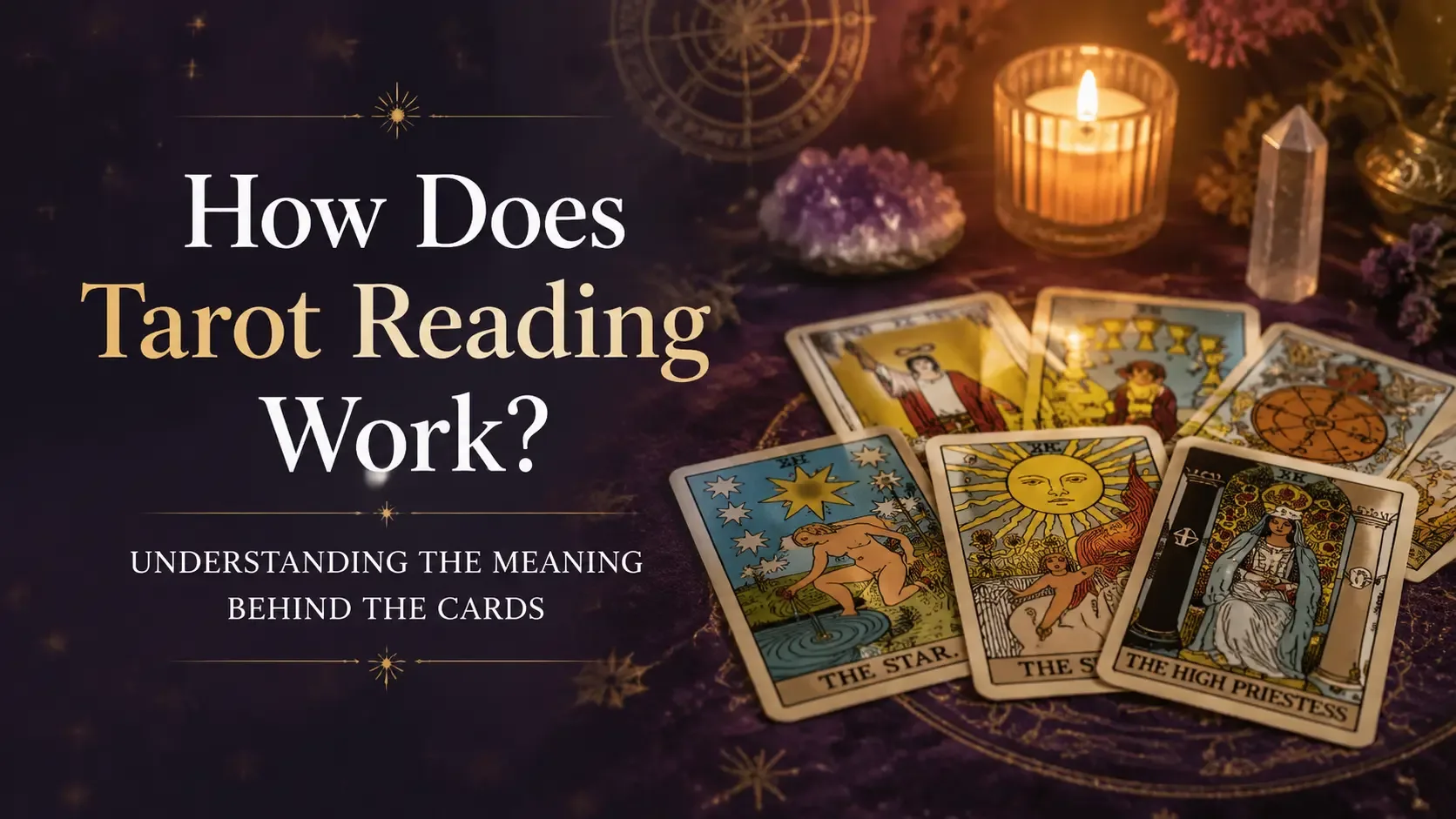
Tarot reading has fascinated people for centuries. Some see tarot as a tool for predicting the future, while others view it as a method of self-reflection, spiritual guidance, and understanding hidden emotions.
But how does tarot reading actually work? Are tarot cards simply a form of fortune telling, or is there a deeper meaning behind the symbols, images, and patterns found in the deck?
In this guide, we will explore how tarot works, how tarot readers interpret cards, and how the meanings behind the cards can provide insight into different areas of life such as love, career, relationships, and personal growth.
What Is Tarot Reading?
Tarot reading is a practice that uses a deck of symbolic cards to explore questions, emotions, and possible life situations.
A traditional tarot deck contains 78 cards, divided into two main groups:
22 Major Arcana cards
56 Minor Arcana cards
Each card contains unique symbols, images, numbers, and archetypal meanings. During a reading, cards are drawn and interpreted according to their position, relationship with other cards, and the question being asked.
Unlike a simple prediction system, tarot is often used as a way to reveal perspectives that may already exist within the subconscious mind.
How Does Tarot Reading Work?
Many people wonder how a deck of cards can provide meaningful guidance. The answer lies in the relationship between symbolism, intuition, and interpretation.
1. The Question Creates the Focus
A tarot reading usually begins with a question or intention.
For example:
"What should I understand about my current relationship?"
"What challenges am I facing in my career?"
"What direction should I consider moving toward?"
The question helps focus the reader's attention and provides a framework for interpreting the cards.
A well-designed tarot question is usually open-ended rather than a simple yes-or-no question.
Instead of asking:
"Will I get this job?"
A tarot reader may ask:
"What can I learn about my career opportunities at this time?"
This allows tarot to provide deeper insight rather than only a fixed answer.
2. Tarot Cards Use Symbolic Language
The power of tarot comes from symbols.
Each card represents certain themes, emotions, and life experiences.
For example:
The Fool
The Fool represents:
New beginnings
Adventure
Taking risks
Trusting the journey
It often appears when someone is entering an unfamiliar stage of life.
The Lovers
The Lovers card represents:
Relationships
Choices
Harmony
Values and personal alignment
Although many people associate it only with romance, its deeper meaning involves important choices and commitments.
The Tower
The Tower symbolizes:
Sudden changes
Breaking old structures
Unexpected revelations
While it may seem negative, it can also represent liberation and necessary transformation.
Tarot cards are not simply "good" or "bad." Their meaning depends on the situation and surrounding cards.
3. The Meaning of Tarot Cards Changes Through Context
One of the most important principles in tarot reading is that a card does not have only one fixed meaning.
For example, the Death card is often misunderstood.
Many beginners believe Death means physical death, but in tarot interpretation it usually represents:
Transformation
Ending of an old phase
Personal renewal
Letting go
The same card can have different meanings depending on:
The question
The position in the spread
The surrounding cards
The reader's interpretation
Tarot works more like a language than a dictionary.
A single word can have different meanings depending on the sentence. Tarot cards work in a similar way.
The Role of Major Arcana and Minor Arcana
Major Arcana: The Big Lessons of Life
The 22 Major Arcana cards represent major life themes and spiritual lessons.
They include famous cards such as:
The Magician
The High Priestess
The Empress
The Emperor
The Wheel of Fortune
The Hermit
The Star
The Sun
The World
When many Major Arcana cards appear in a reading, it often suggests that the situation involves significant personal growth or important life changes.
Minor Arcana: Everyday Experiences
The 56 Minor Arcana cards describe daily events, emotions, challenges, and practical situations.
They are divided into four suits:
Wands
Related to:
Creativity
Passion
Action
Ambition
Cups
Related to:
Emotions
Love
Relationships
Intuition
Swords
Related to:
Thoughts
Communication
Conflicts
Decisions
Pentacles
Related to:
Money
Career
Material matters
Physical security
Together, the Major and Minor Arcana create a complete symbolic system for exploring human experiences.
What Happens During a Tarot Reading?
A typical tarot reading usually follows several steps:
Step 1: Choosing a Tarot Spread
A tarot spread is a specific arrangement of cards.
Common spreads include:
One-Card Reading
Used for:
Daily guidance
Quick reflection
A simple question
Three-Card Reading
One of the most popular spreads.
Cards may represent:
Past
Present
Future
or:
Situation
Challenge
Advice
Celtic Cross Spread
A traditional 10-card spread used for deeper analysis of complex situations.
Step 2: Drawing the Cards
The reader shuffles the deck and draws cards.
Some readers believe intuition guides the selection process, while others view the process as a way of randomly presenting symbols for reflection.
Regardless of belief, the important part is how the cards are interpreted.
Step 3: Interpreting the Message
A tarot reader combines several elements:
Traditional card meanings
Visual symbols
Intuition
The person's situation
The relationship between cards
For example, the combination:
The Star + The Sun
may suggest:
Hope after difficulty
Renewed confidence
Positive progress
While:
The Tower + The Devil
might suggest:
Breaking unhealthy patterns
Facing difficult truths
Liberation from limitations
Tarot interpretation is about understanding the story created by the cards.
Is Tarot Predicting the Future?
This is one of the most common questions about tarot.
Different tarot traditions have different beliefs.
Some readers view tarot as a predictive tool that reveals possible future trends.
Others believe tarot does not predict a fixed future but instead shows:
Current energies
Hidden influences
Possible outcomes
Personal choices
A useful way to understand tarot is:
Tarot does not necessarily tell you what will happen. It helps you understand what may happen and how you can respond.
The future is influenced by decisions, actions, and circumstances.
Why Do Tarot Readings Feel Accurate?
Many people experience tarot readings as surprisingly meaningful.
Several factors may contribute:
Symbolic Reflection
Human beings naturally connect with symbols and stories. Tarot images can trigger thoughts and emotions that help people examine their own situations.
Introspection
A tarot reading encourages people to slow down and consider questions they may normally ignore.
Pattern Recognition
The human mind is excellent at finding connections and meanings. Tarot provides a structured framework for exploring these patterns.
How to Learn Tarot Reading
Learning tarot is not only about memorizing 78 card meanings.
A good tarot learner should develop:
1. Understanding Card Symbols
Learn the stories, numbers, colors, and archetypes behind each card.
2. Practicing Intuition
Notice your first impressions when viewing a card.
3. Studying Tarot Spreads
Different spreads reveal different aspects of a question.
4. Keeping a Tarot Journal
Recording readings helps you understand how meanings develop over time.
Tarot as a Tool for Self-Discovery
Whether someone believes tarot is spiritual guidance or psychological reflection, tarot offers a valuable opportunity:
To understand emotions
To explore possibilities
To recognize patterns
To reflect on personal choices
The true power of tarot may not come from the cards themselves, but from the conversation between the symbols and the person seeking insight.
Conclusion: Understanding the Meaning Behind Tarot Cards
Tarot reading works through a combination of symbolism, interpretation, intuition, and personal reflection.
The 78 cards create a rich symbolic language that represents human experiences — from love and ambition to challenges and transformation.
Rather than seeing tarot as a simple method of fortune telling, many modern readers approach it as a tool for gaining perspective and understanding life's journey.
Whether you are a beginner exploring your first tarot deck or an experienced reader developing deeper skills, learning the meaning behind the cards is the first step toward understanding the fascinating world of tarot.
Recommended reading
How to Do Your First Tarot Reading: A Beginner’s Step-by-Step Guide
If you’re new to Tarot, you may have had this thought: “I have a Tarot deck, but where do I actually start?” With 78 cards, different spreads, upright and…
How Many Tarot Cards Are There? Understanding the 78 Tarot Cards
If you are new to Tarot, one of the first questions you may have is surprisingly simple: How many Tarot cards are there? A standard Tarot deck contains 78…
Major Arcana vs Minor Arcana: What Is the Difference?
If you are just beginning to learn Tarot, one of the first things you will notice is that a standard Tarot deck contains 78 cards divided into two major…
Which is Better: Tarot or Lenormand?
When stepping into the world of cartomancy and intuitive card reading, two systems dominate the space: Tarot and Lenormand. If you are trying to decide which system to learn—or which type of reading is right for your current situation—you might wonder: Which one is actually better? The short answer is: Neither is objectively "better," but they are built for entirely different purposes. Tarot acts as a psychological mirror for internal reflection, while Lenormand acts as a practical lens for clear, real-world answers. Here is a deep dive into how they differ, how they work, and how to choose the right one for you.
What is the Difference Between Traditional and Modern Tarot Card Reading?
For centuries, Tarot cards have captured human imagination, evolving from a 15th-century European parlor game into one of the most widely used tools for self-reflection and guidance worldwide. However, if you compare a Tarot session from the 19th century with a reading done today, you will notice a profound shift in mindset, interpretation, and intent. The core symbols on the 78 cards remain largely the same, but how we approach and use them has fundamentally transformed.