Major Arcana vs Minor Arcana: What Is the Difference?
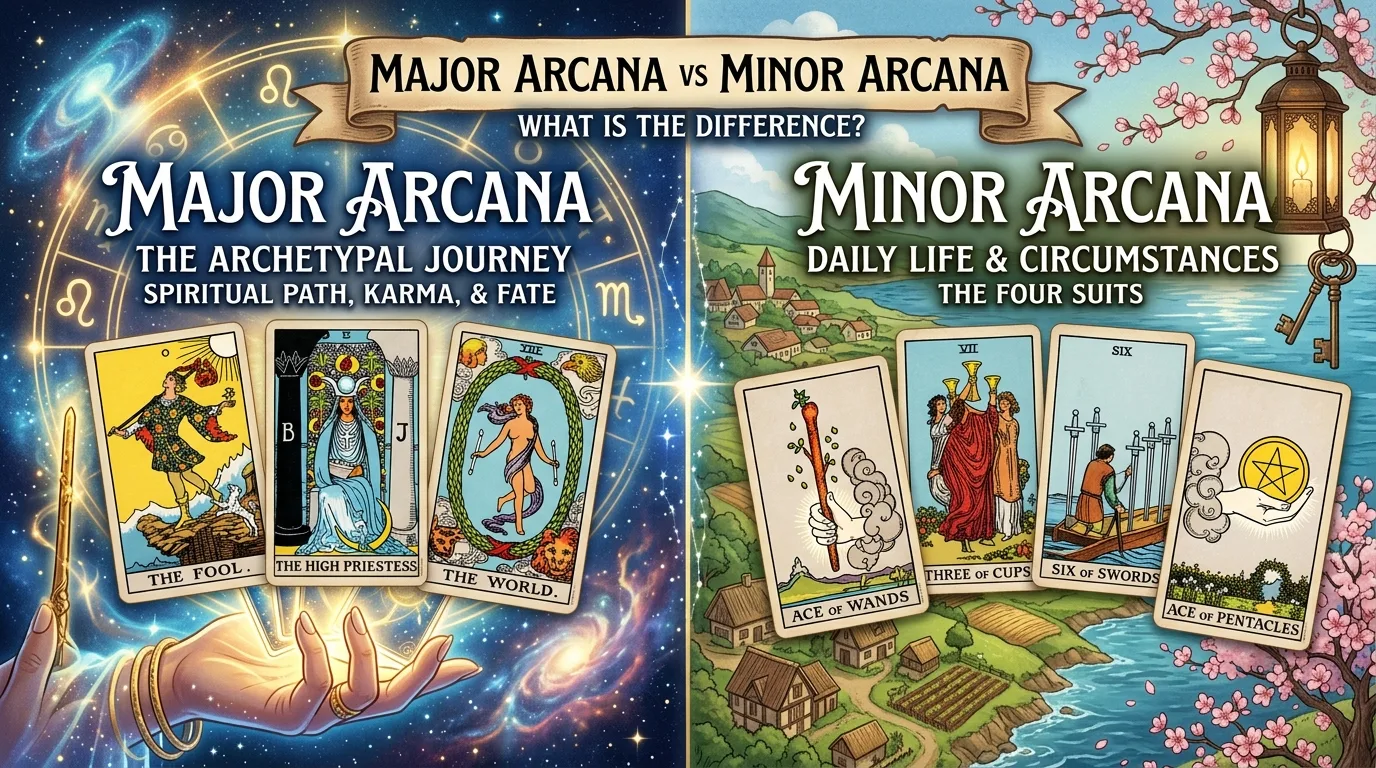
If you are just beginning to learn Tarot, one of the first things you will notice is that a standard Tarot deck contains 78 cards divided into two major groups: the Major Arcana and the Minor Arcana.
At first, the distinction may seem simple: 22 cards on one side and 56 on the other. But understanding why Tarot is structured this way can make a big difference in how you interpret a reading.
The Major Arcana tends to describe the larger themes, turning points, and deeper patterns of life. The Minor Arcana brings those themes down into everyday experiences—relationships, work, emotions, decisions, conflicts, money, and ordinary events.
In simple terms:
Major Arcana shows the bigger story. Minor Arcana shows how that story plays out in daily life.
Let's take a closer look.
The Basic Structure of a Tarot Deck
A traditional 78-card Tarot deck contains:
22 Major Arcana cards
56 Minor Arcana cards
The Major Arcana runs from The Fool (0) through The World (XXI).
The Minor Arcana consists of four suits:
Wands
Cups
Swords
Pentacles
Each suit contains 14 cards:
Ace through Ten
Page
Knight
Queen
King
This gives us:
4 suits × 14 cards = 56 Minor Arcana cards.
Together, these 78 cards form the complete Tarot system.
What Is the Major Arcana?
The Major Arcana consists of 22 cards, beginning with The Fool and ending with The World.
These cards are often associated with major archetypal themes and significant stages of human experience.
Some familiar examples include:
The Fool — beginnings, freedom, taking a leap
The Magician — ability, initiative, manifestation
The High Priestess — intuition, mystery, hidden knowledge
The Lovers — relationships, values, choices
The Chariot — determination, direction, control
Death — transformation and endings
The Tower — disruption, revelation, sudden change
The Star — hope, healing, renewal
The Sun — clarity, vitality, success
The World — completion and integration
The sequence from The Fool to The World is often interpreted as a symbolic journey of development known as the Fool's Journey.
The important point is that Major Arcana cards generally operate at a larger level of meaning.
For example, if you ask:
"What is happening in my career right now?"
and draw The Tower, the card does not necessarily mean that you will literally lose your job tomorrow.
It may instead point to a larger process of restructuring: an old career direction may no longer be sustainable, a belief about your work may be collapsing, or an unexpected event may force you to reconsider your plans.
The Major Arcana often asks:
What is this experience really about?
What Is the Minor Arcana?
The Minor Arcana contains 56 cards and is divided into four suits.
While the Major Arcana tends to describe larger themes, the Minor Arcana is much closer to the details of everyday life. It can describe what someone is thinking, feeling, doing, experiencing, or dealing with at a particular moment.
Wands
Wands are traditionally associated with Fire.
They often relate to:
Action
Energy
Passion
Creativity
Ambition
Motivation
Personal projects
For example, the Three of Wands might describe looking toward future possibilities, while the Five of Wands can indicate competition, disagreement, or friction.
Cups
Cups are associated with Water.
They often concern:
Emotions
Love
Relationships
Intuition
Connection
Emotional fulfillment
The Two of Cups, for example, can highlight connection and mutual attraction, while the Five of Cups may focus attention on disappointment, grief, or what has been lost.
Swords
Swords are associated with Air.
They often relate to:
Thoughts
Communication
Decisions
Conflict
Beliefs
Mental tension
The Ace of Swords can suggest clarity or a new understanding, while the Five of Swords may point toward conflict, disagreement, or difficult interpersonal dynamics.
Pentacles
Pentacles, also called Coins in some decks, are associated with Earth.
They often concern:
Money
Work
Career
Material security
Health and the physical world
Practical responsibilities
The Eight of Pentacles, for example, can emphasize learning, practice, craftsmanship, and developing a skill.
The four suits therefore give the Minor Arcana different "territories" of experience.
Major Arcana vs Minor Arcana: The Main Difference
The easiest way to understand the difference is to think in terms of scale.
Major Arcana | Minor Arcana |
|---|---|
22 cards | 56 cards |
The Fool to The World | Four suits |
Major life themes | Everyday experiences |
Archetypal patterns | Specific situations |
Turning points | Day-to-day developments |
Deeper lessons | Practical details |
Larger context | Immediate circumstances |
But there is an important qualification:
"Major" does not mean "good," and "Minor" does not mean "unimportant."
A Minor Arcana card can describe something extremely important to you.
The distinction is primarily about the level and type of experience being described, not a simple ranking of importance.
A Simple Example: The Tower vs. Eight of Swords
Consider two very different cards:
The Tower is Major Arcana.
Eight of Swords is Minor Arcana.
Both can potentially describe a difficult situation.
But they approach the problem differently.
The Tower may describe a major disruption: something that fundamentally changes the situation or destroys an existing structure.
The Eight of Swords may describe feeling mentally trapped, restricted, uncertain, or unable to see a way forward.
One describes a larger disruptive process.
The other describes the person's experience within a particular situation.
This distinction becomes particularly useful when several cards appear together.
How Major and Minor Arcana Work Together
A Tarot reading rarely requires you to choose between Major and Minor Arcana.
They are designed to work together.
Imagine a three-card reading produces:
The Tower — Five of Pentacles — Six of Swords
You could read the cards as a progression.
The Tower establishes the larger disruption.
Five of Pentacles describes the immediate experience of insecurity, difficulty, or feeling excluded.
Six of Swords suggests gradually moving away from the difficult situation toward something calmer.
The Major Arcana gives us the larger event or theme, while the Minor Arcana helps explain the specific experience and development surrounding it.
This is one reason a complete Tarot deck is much more expressive than using only the Major Arcana.
What Does It Mean When a Reading Has Many Major Arcana Cards?
This is a useful thing for beginners to notice.
Suppose you pull five cards and four of them are Major Arcana.
You might ask:
Why are there so many Major Arcana cards?
A common interpretation is that the reading concerns a significant period, major transition, or deeper life theme, rather than simply a temporary everyday issue.
For example, a spread containing:
The Hermit — Death — The Star — The World
would suggest a very different kind of reading from one containing:
Three of Cups — Eight of Pentacles — Two of Wands — Four of Pentacles.
The first spread has a strong sense of transformation, reflection, renewal, and completion.
The second is much more grounded in relationships, work, planning, and material concerns.
This does not mean the first spread is "more powerful" in an absolute sense. It simply operates at a different level.
Does the Minor Arcana Matter Less?
This is one of the biggest misconceptions beginners encounter.
The answer is no.
Without the Minor Arcana, Tarot would become much less precise.
Imagine asking:
"Will I get the job?"
A Major Arcana card might tell you that the situation represents an important turning point in your career.
But a Minor Arcana card can provide much more situational detail.
For example:
Three of Pentacles — skills and collaboration
Eight of Pentacles — preparation and practice
Six of Wands — recognition or success
Five of Pentacles — insecurity or difficulty
Two of Swords — uncertainty or indecision
The Minor Arcana often tells us what is happening on the ground.
That's extremely useful in an actual reading.
The Major Arcana Gives the Context; the Minor Arcana Gives the Details
A useful analogy is to think of Tarot as a movie.
The Major Arcana describes the major plot.
The Minor Arcana describes the scenes.
For example:
The Chariot might indicate a period of determination, movement, and taking control.
Then the Minor Arcana can tell you where that energy is being expressed:
Wands → action and ambition
Cups → relationships and emotions
Swords → decisions and mental conflict
Pentacles → work and material matters
This gives Tarot readings their flexibility.
The Major Arcana can tell you why something matters, while the Minor Arcana can help show how it is happening.
A Good Way to Learn Tarot
If you are learning Tarot for the first time, it is usually helpful to begin with the Major Arcana.
There are only 22 cards, and their sequence gives you a natural framework for learning Tarot symbolism.
Start with:
The Fool → The Magician → The High Priestess → ... → The World
Rather than memorizing isolated keywords, try to understand the journey from one card to the next.
Then move into the Minor Arcana.
Once you understand the four suits, you can begin to recognize patterns within them.
For example, the numbered cards can be studied as developments within each suit:
Ace → beginning
Two → balance or choice
Three → development
Four → stability
Five → tension or disruption
Six → adjustment or movement
Seven → challenge or evaluation
Eight → movement or development
Nine → culmination
Ten → completion
These patterns are not rigid rules, but they can give beginners a useful framework for understanding unfamiliar cards.
Major Arcana vs Minor Arcana: A Quick Summary
If you only remember five things from this article, remember these:
1. A standard Tarot deck contains 78 cards.
There are 22 Major Arcana and 56 Minor Arcana cards.
2. The Major Arcana deals with larger themes.
These include transformation, identity, major choices, life transitions, and other archetypal experiences.
3. The Minor Arcana deals with everyday life.
Its four suits cover emotional, practical, mental, and energetic dimensions of experience.
4. Neither group is "better."
Major does not mean good, and Minor does not mean insignificant.
5. They work best together.
The Major Arcana provides the broader context, while the Minor Arcana adds detail and practical expression.
Final Thoughts
The difference between the Major and Minor Arcana is one of the foundations of Tarot.
The Major Arcana gives us the larger journey: beginnings, choices, challenges, transformation, revelation, and completion.
The Minor Arcana brings that journey into everyday life: the conversations we have, the decisions we make, the relationships we experience, the work we do, and the emotions we move through.
You could think of it this way:
Major Arcana tells you what chapter of the story you are in. Minor Arcana tells you what is happening in the chapter.
Once you start seeing the two groups this way, Tarot becomes much easier to read. Instead of memorizing 78 completely separate meanings, you begin to see a system in which cards interact, reinforce one another, and tell a larger story.
And that is where Tarot starts becoming much more interesting than a simple collection of card meanings.
Recommended reading
The Magician Tarot Card Meaning: Manifestation and Personal Power
The Magician is the first numbered card of the Major Arcana in the Tarot. Associated with manifestation, personal power, communication, skill, and conscious…
The Fool Tarot Card Meaning: New Beginnings and Unlimited Possibilities
The Fool is the first card of the Major Arcana in the Tarot deck, numbered 0 . Although The Fool is traditionally placed at the beginning of the Major Arcana…
How to Do Your First Tarot Reading: A Beginner’s Step-by-Step Guide
If you’re new to Tarot, you may have had this thought: “I have a Tarot deck, but where do I actually start?” With 78 cards, different spreads, upright and…
How Does Tarot Reading Work? Understanding the Meaning Behind the Cards
Tarot reading has fascinated people for centuries. Some see tarot as a tool for predicting the future, while others view it as a method of self-reflection…
What Is Tarot? A Beginner’s Guide to Tarot Cards and Readings
If you have ever caught a glimpse of a mesmerizing deck of Tarot cards, adorned with centuries-old imagery and mysterious symbolism, you might have felt a…