How Many Tarot Cards Are There? Understanding the 78 Tarot Cards
If you are new to Tarot, one of the first questions you may have is surprisingly simple:
How many Tarot cards are there?
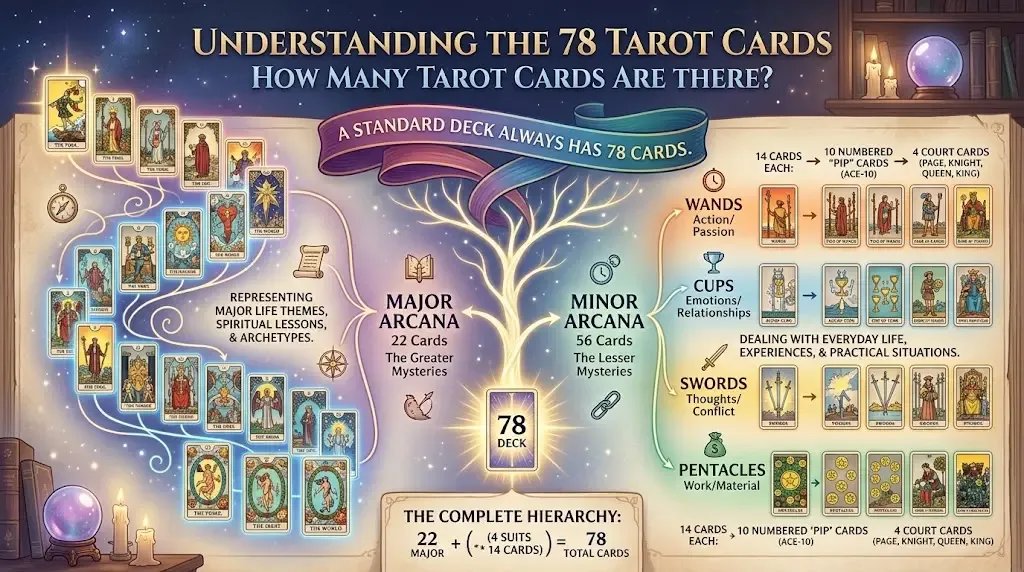
A standard Tarot deck contains 78 cards.
These 78 cards are divided into two main sections:
22 Major Arcana cards
56 Minor Arcana cards
Together, they form the traditional Tarot deck used for readings, study, and divination.
But why are there exactly 78 cards? And what is the difference between the Major and Minor Arcana?
Let's take a closer look at how the Tarot deck is organized.
The 78 Tarot Cards at a Glance
The easiest way to understand a Tarot deck is to divide it into its two major parts.
Part of the Deck | Number of Cards | Main Focus |
|---|---|---|
Major Arcana | 22 | Major life themes and significant experiences |
Minor Arcana | 56 | Everyday situations, emotions, actions, and relationships |
Total | 78 | Complete Tarot deck |
The structure is actually quite logical once you see it this way.
The Major Arcana contains the cards numbered from 0 to 21, beginning with The Fool and ending with The World.
The Minor Arcana consists of four suits, with 14 cards in each suit.
So:
22 + (14 × 4) = 78
That's the basic mathematical structure of a traditional Tarot deck.
What Are the 22 Major Arcana Cards?
The Major Arcana is made up of 22 cards, traditionally numbered from 0 to XXI.
The sequence begins with The Fool (0) and ends with The World (XXI).
The Major Arcana cards are generally associated with larger themes and important stages of human experience.
The 22 cards are:
The Fool
The Magician
The High Priestess
The Empress
The Emperor
The Hierophant
The Lovers
The Chariot
Strength
The Hermit
Wheel of Fortune
Justice
The Hanged Man
Death
Temperance
The Devil
The Tower
The Star
The Moon
The Sun
Judgement
The World
There is one small detail worth mentioning: The Fool is normally numbered 0, while The World is numbered XXI. Therefore, the numerical sequence technically runs from 0 through 21.
Why Is the Major Arcana Important?
The Major Arcana is often used to explore significant developments rather than only small day-to-day events.
For example:
The Tower may point toward sudden disruption or the collapse of an existing structure.
The Lovers can relate to relationships, but may also concern choices, values, and personal alignment.
The Hermit often speaks to introspection, solitude, and searching for deeper understanding.
The World is associated with completion, integration, and the end of a major cycle.
This doesn't mean that a Major Arcana card always predicts a dramatic event.
Its meaning depends on the question, surrounding cards, position in the spread, and the particular Tarot tradition being used.
What Are the 56 Minor Arcana Cards?
The remaining 56 cards make up the Minor Arcana.
They are divided into four suits:
Wands
Cups
Swords
Pentacles
Each suit contains 14 cards.
That gives us:
14 cards × 4 suits = 56 cards
The structure of each suit is:
Ace
Two
Three
Four
Five
Six
Seven
Eight
Nine
Ten
Page
Knight
Queen
King
The Ace through Ten are commonly called the pip cards, while Page, Knight, Queen, and King are known as Court Cards.
The Four Tarot Suits
Each suit tends to emphasize a different area of experience.
Wands
Wands are commonly associated with energy, creativity, ambition, action, and inspiration.
They often appear in readings involving projects, personal motivation, career ambitions, or the desire to move forward.
For example, the Ace of Wands can represent a new spark of enthusiasm, an idea, or the beginning of an exciting project.
Cups
Cups are traditionally connected with emotions, relationships, intuition, affection, and inner experiences.
Because of this, Cups frequently appear in questions about love and relationships.
The Two of Cups, for instance, is often associated with connection, partnership, and mutual attraction.
Swords
Swords are associated with thought, communication, decisions, conflict, and mental challenges.
They can represent the way we think about a situation as well as difficulties that arise through communication or competing ideas.
The Ace of Swords, for example, can suggest clarity, truth, a new understanding, or an important decision.
Pentacles
Pentacles are commonly connected with the material world, including money, work, resources, health, possessions, and practical matters.
The Ace of Pentacles may indicate a new practical opportunity, such as a financial possibility, job opportunity, or foundation for future growth.
Why Are There 14 Cards in Each Suit?
The 14-card structure is one of the defining features of the traditional Tarot deck.
Each suit contains:
10 numbered cards + 4 Court Cards = 14 cards
And because there are four suits:
4 × 14 = 56 Minor Arcana cards
Then:
56 Minor Arcana + 22 Major Arcana = 78 cards
This structure is shared by many of the most familiar Tarot traditions, including the Rider-Waite-Smith Tarot and decks based on similar systems.
What Do the Numbers in Tarot Mean?
The numbered Minor Arcana cards aren't simply a collection of unrelated cards.
The numbers themselves can provide another layer of interpretation.
A simplified way to look at the progression is:
Ace — beginning or potential
Two — duality, balance, or choice
Three — development and expansion
Four — stability and structure
Five — change, tension, or challenge
Six — movement, harmony, or adjustment
Seven — testing, reflection, or strategy
Eight — movement, structure, or development
Nine — culmination and personal experience
Ten — completion or the end of a cycle
The exact meaning changes depending on the suit.
For example, the Five of Cups and the Five of Pentacles both contain the number five, but their meanings are very different because Cups and Pentacles deal with different aspects of life.
This is one of the reasons learning Tarot is more useful than simply memorizing 78 individual definitions.
What Are the Court Cards?
Each suit has four Court Cards:
Page, Knight, Queen, and King.
These cards can represent people, personalities, approaches, stages of development, or particular kinds of energy.
For example, a Page of Cups might suggest emotional openness, curiosity, or the beginning of a new emotional experience.
A Queen of Cups may represent emotional maturity, empathy, intuition, and sensitivity.
A King of Swords can suggest intellectual authority, clear judgment, logic, and disciplined thinking.
Court Cards can be challenging for beginners because they don't always represent literal people.
Their interpretation depends heavily on the question and surrounding cards.
Are All Tarot Decks 78 Cards?
No.
This is an important distinction.
When people say "a Tarot deck has 78 cards," they are referring to the standard Tarot structure.
However, modern Tarot creators sometimes change the traditional structure.
Some decks may:
Add extra cards
Remove certain cards
Rename cards
Change the number of cards in a suit
Create entirely new systems inspired by Tarot
There are also historical Tarot decks with structures that differ from the modern 78-card format.
So 78 cards is the traditional standard, not an absolute rule for every deck that uses the word Tarot.
What About Oracle Cards?
This is where beginners sometimes get confused.
Tarot and Oracle cards are not the same system.
A traditional Tarot deck follows a recognizable structure of 78 cards, divided into Major and Minor Arcana.
Oracle decks do not have to follow this structure.
An Oracle deck might contain:
30 cards
44 cards
50 cards
60 cards
or virtually any number chosen by the creator
The cards can also follow completely different themes and systems.
So if you see a deck with 44 beautifully illustrated cards, for example, it may be an Oracle deck rather than a traditional Tarot deck.
Do You Need to Memorize All 78 Tarot Cards?
Not necessarily.
This is probably one of the biggest concerns among people who are just starting Tarot.
Looking at 78 cards and thinking, "I have to memorize all of these meanings" can make Tarot seem much harder than it really is.
A better approach is to understand the structure.
Learn the 22 Major Arcana as a broad journey through different human experiences.
Then learn the four suits of the Minor Arcana:
Wands = energy and action
Cups = emotions and relationships
Swords = thoughts and communication
Pentacles = material and practical life
Once you understand those four categories, the numbered cards become much easier to interpret.
For example, if you encounter a Seven of Cups, you already know that:
Seven relates to a particular stage of development or challenge.
Cups relate to emotions, relationships, imagination, and inner experience.
You can then begin connecting those ideas instead of trying to recall one fixed sentence from a textbook.
Why Does Tarot Have 78 Cards?
There isn't one universally accepted explanation that says, "This is the single reason Tarot contains exactly 78 cards."
The modern Tarot structure developed through a long historical process, and different Tarot traditions have interpreted its symbolism in different ways.
It is therefore better to distinguish between the historical structure of Tarot and later systems of symbolic interpretation.
Today, however, the 78-card structure provides a remarkably flexible system.
The Major Arcana gives us broad archetypal themes, while the Minor Arcana brings those themes into more ordinary areas of life.
Together, they create a system that can be used to explore questions about relationships, work, personal development, decisions, emotions, and many other subjects.
The 78 Tarot Cards: A Simple Way to Remember the Structure
If you're just starting out, you don't need to memorize everything immediately.
Remember this:
78 Tarot cards
↓
22 Major Arcana
56 Minor Arcana
↓
4 suits
Wands — 14 cards
Cups — 14 cards
Swords — 14 cards
Pentacles — 14 cards
↓
Each suit
Ace–10
Page
Knight
Queen
King
Once this structure becomes familiar, the Tarot deck stops looking like 78 separate cards.
Instead, you begin to see it as a system.
And that's a much easier way to learn Tarot.
Final Thoughts
So, how many Tarot cards are there?
A traditional Tarot deck contains 78 cards: 22 Major Arcana cards and 56 Minor Arcana cards.
The Major Arcana explores larger themes and significant stages of experience, while the Minor Arcana is divided into four suits that deal with more everyday aspects of life.
If you're learning Tarot for the first time, don't worry about memorizing all 78 cards at once. Understanding the structure of the deck is a much better starting point.
Once you understand how the Major Arcana, four suits, numbers, and Court Cards fit together, reading individual cards becomes much more intuitive.
Recommended reading
The History of Tarot: From Playing Cards to Spiritual Guidance
The History of Tarot: From Playing Cards to Spiritual Guidance Tarot cards are now widely associated with fortune telling, spiritual guidance, self-reflection…
How Does Tarot Reading Work? Understanding the Meaning Behind the Cards
Tarot reading has fascinated people for centuries. Some see tarot as a tool for predicting the future, while others view it as a method of self-reflection…
What Is Tarot? A Beginner’s Guide to Tarot Cards and Readings
If you have ever caught a glimpse of a mesmerizing deck of Tarot cards, adorned with centuries-old imagery and mysterious symbolism, you might have felt a…
Which is Better: Tarot or Lenormand?
When stepping into the world of cartomancy and intuitive card reading, two systems dominate the space: Tarot and Lenormand. If you are trying to decide which system to learn—or which type of reading is right for your current situation—you might wonder: Which one is actually better? The short answer is: Neither is objectively "better," but they are built for entirely different purposes. Tarot acts as a psychological mirror for internal reflection, while Lenormand acts as a practical lens for clear, real-world answers. Here is a deep dive into how they differ, how they work, and how to choose the right one for you.
What is the Difference Between Traditional and Modern Tarot Card Reading?
For centuries, Tarot cards have captured human imagination, evolving from a 15th-century European parlor game into one of the most widely used tools for self-reflection and guidance worldwide. However, if you compare a Tarot session from the 19th century with a reading done today, you will notice a profound shift in mindset, interpretation, and intent. The core symbols on the 78 cards remain largely the same, but how we approach and use them has fundamentally transformed.